
Overcontrol is a coping style marked by excessive self-control, perfectionism, emotional inhibition, and rigidity. It often looks adaptive on the surface because the person may appear calm, competent, thoughtful, and highly responsible, but underneath that polished exterior there is often loneliness, tension, and difficulty with openness and connection.
This matters because overcontrol rarely causes the dramatic interpersonal explosions people often associate with emotional struggle. Instead, it tends to show up in quieter ways: difficulty relaxing, chronic self-criticism, reluctance to be vulnerable, rigid expectations, and a tendency to prioritize getting things right over staying emotionally connected.
What overcontrol is
In Radically Open Dialectical Behavior Therapy (RO DBT), overcontrol is understood as a pattern of excessive self-regulation that becomes problematic when it interferes with flexibility, emotional expression, and social connectedness. While self-control can be valuable, RO DBT emphasizes that too much control can become just as impairing as too little, especially when it leads to chronic emotional loneliness or rigid, rule-governed living.
Overcontrolled people are often described as serious, restrained, perfectionistic, and difficult to read emotionally. They may work hard, delay gratification, follow rules closely, and pride themselves on composure, yet still struggle deeply with intimacy, adaptability, and feeling known by others.
How overcontrol shows up
Overcontrol often presents through four broad patterns that therapists and loved ones can learn to recognize.
Low openness and receptivity: difficulty taking in feedback, guardedness, hypervigilance, discomfort with uncertainty, and a tendency to stay defended rather than curious.
Low flexible-control: rigid habits, compulsive planning, perfectionism, black-and-white thinking, and distress when things do not go according to plan.
Inhibited emotional expression: under-reporting distress, appearing flat or overly composed, smiling when upset, and struggling to communicate internal states clearly.
Low social connectedness: feeling distant from others, difficulty with vulnerability, and a persistent sense of being on the outside even in close relationships.
In everyday life, this may look like overthinking simple decisions, replaying interactions, needing things done in a particular way, suppressing disappointment, and finding it hard to be playful or spontaneous. A person with overcontrol may be praised for being dependable while privately feeling exhausted, misunderstood, or emotionally alone.
Overcontrol in relationships
In relationships, overcontrol usually shows up less as obvious dominance and more as emotional distance, rigidity, and difficulty with vulnerability. The person may love deeply and be very loyal, but their partner often experiences them as hard to read, hard to reach, or overly focused on correctness instead of connection.
Common relationship signs include:
Struggling to express needs directly and instead becoming quiet, tense, or resentful.
Having rigid ideas about the right way to communicate, clean, plan, or solve problems.
Offering practical help more easily than emotional openness.
Feeling uncomfortable with spontaneity, silliness, or unstructured closeness.
Keeping distress private until it leaks out as criticism, shutdown, or detachment.
This creates a painful pattern: the overcontrolled partner may believe they are being responsible, calm, or considerate, while the other partner feels unseen, judged, or emotionally alone. Because RO DBT frames overcontrol as a social-signaling problem, the issue is often not lack of caring, but that caring is expressed in ways that do not reliably communicate warmth, vulnerability, or receptivity.
It is also important to distinguish emotional overcontrol from coercive or abusive control. Overcontrol in the RO DBT sense centers on inhibition, rigidity, and relational distance, whereas coercive control involves intimidation, domination, surveillance, isolation, or threats, which raise a separate safety concern and should not be minimized by labeling them as personality style.
Overcontrol in the workplace
In the workplace, overcontrol is often misread as pure strength because many of its traits are socially rewarded. Detail orientation, restraint, high standards, conscientiousness, and reliability can all help someone succeed professionally, at least for a while.
But the same traits that look productive can become costly when they harden into perfectionism and inflexibility. Research and clinical writing on perfectionism suggest that perfectionistic employees do not necessarily perform better; instead, they may overinvest in minor details, struggle to delegate, procrastinate out of fear of mistakes, and burn themselves out trying to eliminate uncertainty.
Common workplace signs include:
Spending excessive time refining tasks beyond what is necessary.
Difficulty delegating because others will not do it the right way.
Hesitating to submit work due to fear of flaws or criticism.
Overpreparing, overthinking, and getting stuck in analysis rather than action.
Micromanaging others when responsible for a team or project.
Unlike in intimate relationships, where overcontrol often leads to visible relational strain, workplace overcontrol may initially be rewarded with praise. The problem is that the person may look high-functioning while experiencing chronic tension, reduced flexibility, and increasing exhaustion behind the scenes.
Relationships versus work
The main difference is not the core trait, but the context in which that trait is expressed. In relationships, overcontrol tends to impair warmth, openness, and mutual attunement. At work, it tends to impair efficiency, delegation, and adaptability.
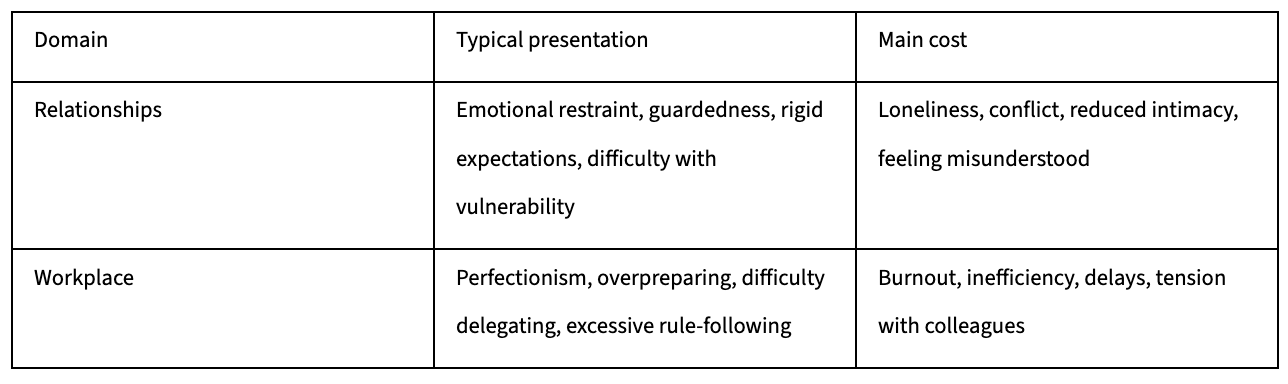
Relationship vs Workspace
This contrast can be clinically useful because many overcontrolled people first recognize the problem in one domain but not the other. Someone may say, “I am just organized at work,” while not realizing the same rigidity is making closeness difficult at home.
How to help a partner who struggles with emotional overcontrol
Helping a partner with emotional overcontrol is less about forcing emotional disclosure and more about creating repeated experiences of safety, openness, and nonjudgment. Because overcontrol often develops in contexts where emotional expression felt risky, pressure usually backfires, while warmth and steadiness create better conditions for change.
A few principles are especially helpful:
Talk during calm moments, not during escalation, so the nervous system is more available for openness.
Use direct, noncritical language and describe personal feelings rather than diagnosing the partner’s behavior.
Validate what is shared instead of immediately fixing, correcting, or debating it.
Encourage low-stakes emotional expression, such as naming feelings, describing body sensations, or sharing one vulnerable thought at a time.
Gently question rigidity by exploring whether something is the only right way or simply one possible way.
Modeling openness also matters. When one partner consistently shares feelings in a grounded and non-blaming way, it can make vulnerability feel less dangerous and more relationally normal over time.
RO DBT also emphasizes the role of social-safety cues, such as warm tone, relaxed facial expression, and subtle friendliness signals, because these cues help reduce threat and increase receptivity. In practice, this means that softening the interaction often matters as much as the words being said.
If the pattern is chronic or significantly affecting the relationship, therapy can be helpful, especially with a clinician familiar with RO DBT or other approaches that target emotional inhibition, perfectionism, and social signaling. This is particularly important when the couple feels stuck in repeated cycles of shutdown, criticism, loneliness, or “I don’t know what I feel” conversations that never move forward.
Clinical takeaway
Overcontrol is easy to miss because it often hides behind traits that are admired: composure, responsibility, discipline, and high standards. But when that self-control becomes so rigid that it blocks flexibility, authentic expression, and social connection, it can contribute to deep relational pain and chronic internal distress.
For therapists, partners, and overcontrolled individuals themselves, the key shift is moving from valuing control alone to valuing openness as well. The goal is not to become impulsive or emotionally flooded, but to become more flexible, more expressive, and more willing to let connection matter as much as correctness.
